

What it does
Instant Detect is a wildlife, environment and threat monitoring system designed specifically for conservationists and wildlife rangers. Cameras are deployed across a site and form a local LoRa radio network, with individual cameras sitting 2–20 km from the Base Station depending on terrain and line of sight. A single Base Station relays all data via Iridium satellite to the cloud — so even from somewhere truly remote, images and alerts reach you the same day.
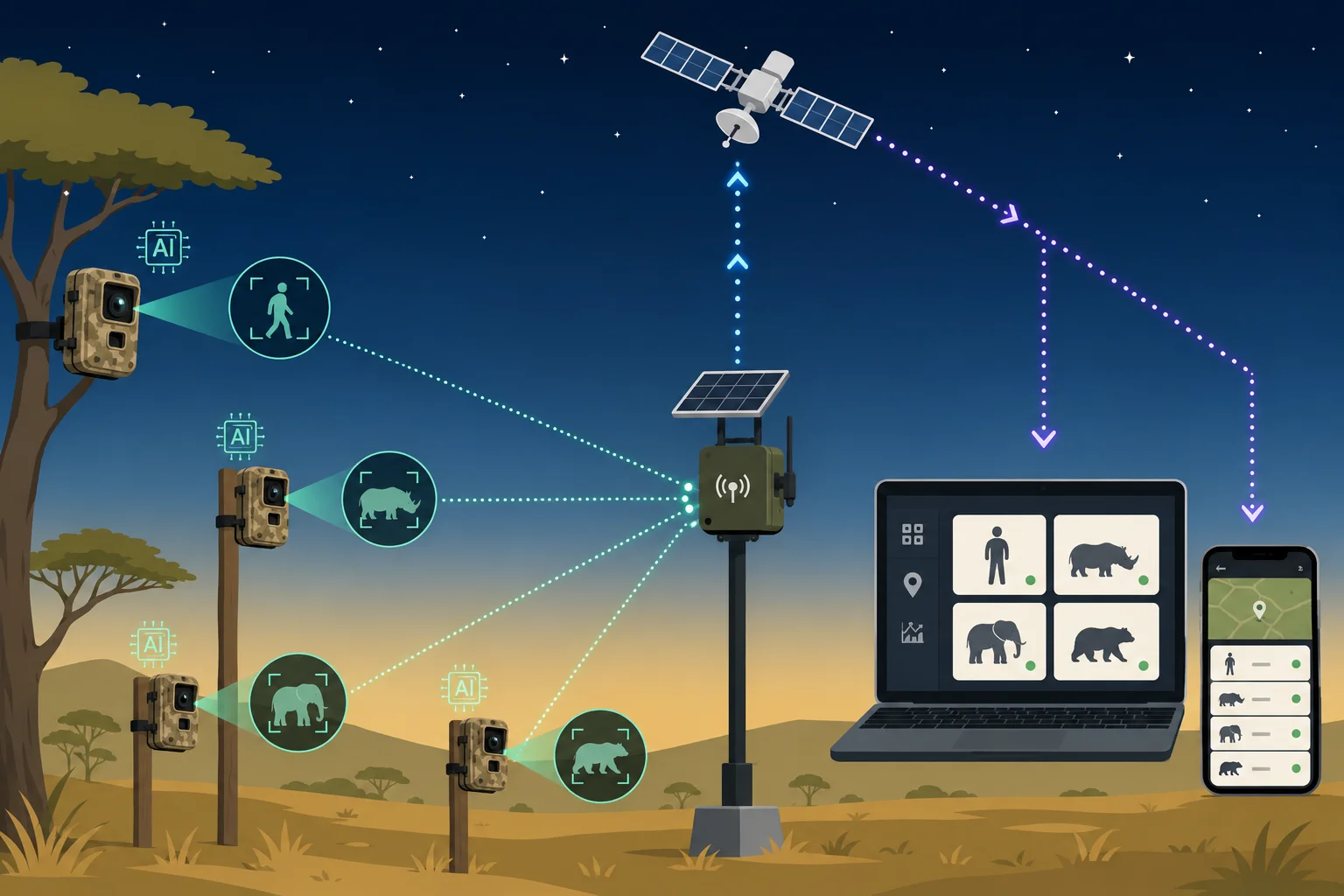
On-device AI: the unique advantage
Each Instant Detect camera runs species-recognition AI directly on the device. That sounds technical, but the practical impact is huge: instead of sending every snapshot to the cloud (and your inbox), the camera understands what it’s looking at, on the spot, and only forwards what matters.
In practice this means you can:
- Trigger real-time interventions the moment a detection happens — because the AI runs on the device itself, the system can act instantly without waiting for a server round-trip. This is exactly what makes our Smart Deterrent possible: detect a problem species and respond on the spot.
- Get alerts only when a specific species appears — elephants, hippos, brown bears, whatever you’re tracking
- Filter out everything except human activity — turning the camera into a silent anti-poaching watchman
- Keep satellite bandwidth (and your team’s attention) focused on signal, not noise
This is unusual in the camera-trap category — most systems either don’t run AI, or only do it server-side after the fact. Instant Detect’s on-device intelligence is what makes the rest of the system viable in the field.
Why this exists
Traditional camera traps are great at capturing wildlife — and bad at telling anyone about it. Researchers leave them in the field for weeks, retrieve them, and only then learn what they captured. By that time, a poaching incident is long over, an injured animal has moved on, and an opportunity to act has been lost.
Instant Detect was built around a simple idea: get the right image to the right person, fast. Not a livestream of useless triggers — just the few that actually matter, delivered in near-real-time.
A history rooted in conservation science
Instant Detect was originally developed by the Zoological Society of London (ZSL) between 2016 and 2023, in close collaboration with rangers and field scientists. In 2025 stewardship of the platform transferred to Hack The Planet, where we continue to evolve and deploy it for partners around the world.


